Nottingham Forest record sales tell you almost as much about the club as the trophies in the City Ground cabinet do. Forest have spent heavily under Evangelos Marinakis, but the money going out of the door has only ever been possible because of the money coming in – and in the summer of 2026 the Reds banked the single biggest fee in their history. On a deadline day when more names could yet leave Trentside, here are the biggest sales Forest have ever made, and the stories behind them.
Nottingham Forest’s record sale: Elliot Anderson to Manchester City
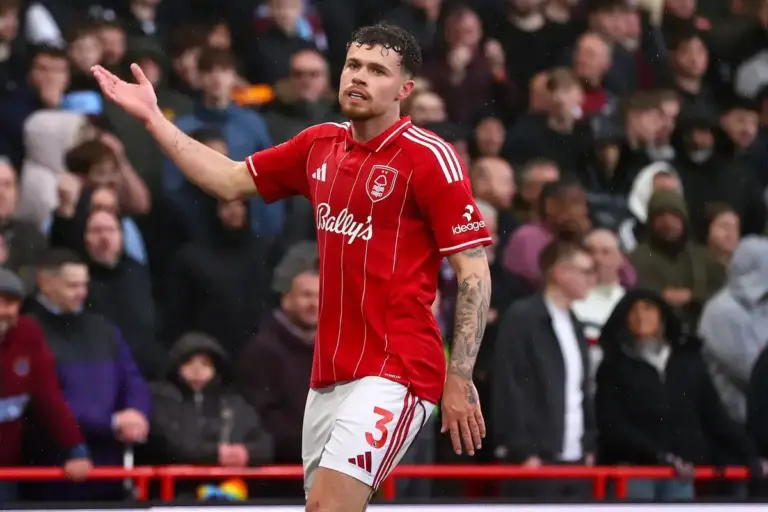
Nothing in Forest’s history comes close. Elliot Anderson, signed from Newcastle United in the summer of 2024 as a midfielder who had barely started a Premier League game, left for Manchester City in the summer of 2026 in a deal reported at around £116 million. In two seasons on the banks of the Trent he went from a squad option to an England international and the most coveted young midfielder in the division.
It is a fee that reframes everything else on this list. Forest’s previous record sale had been comfortably under half of it, and the Anderson money is the reason the Reds were able to smash their own transfer record for Liam Delap this summer without blinking. Sell one, buy three – it is the modern Premier League maths, and Forest have executed it better than most.
The 10 biggest Nottingham Forest sales
All fees are as widely reported at the time, and cross-checked against Transfermarkt’s Forest record departures. Add-ons, sell-on clauses and instalments mean published figures often differ slightly between outlets, so treat these as the accepted headline numbers rather than audited accounts.
- Elliot Anderson – to Manchester City, 2026, around £116m
- Anthony Elanga – to Newcastle United, 2025, around £55m
- Brennan Johnson – to Tottenham Hotspur, 2023, around £47.5m
- Matty Cash – to Aston Villa, 2020, around £16m
- Britt Assombalonga – to Middlesbrough, 2017, around £15m
- Oliver Burke – to RB Leipzig, 2016, around £13m
- Djed Spence – to Tottenham Hotspur, 2022, around £12.5m
- Taiwo Awoniyi – to Coventry City, 2026, around £9m
- Stan Collymore – to Liverpool, 1995, £8.5m
- Michael Dawson and Andy Reid – to Tottenham Hotspur, 2005, around £8m combined
Look at the top three and a pattern jumps out. Anderson, Elanga and Johnson were all sold between the ages of 21 and 24, all after a single standout season, and all to clubs with deeper pockets. That is not an accident. It is a recruitment model.
The sales that changed British football
Two Forest departures belong in a different category altogether, because they were British transfer records in their own right.
In July 1993, Roy Keane left a relegated Forest side for Manchester United in a deal worth a reported £3.75m – a British record at the time, and arguably the single most consequential transfer of the Premier League’s first decade. Brian Clough had signed Keane as an unknown from Cobh Ramblers for a nominal fee. Forest turned that into a record.
Two years later they did it again. Stan Collymore, having scored 25 goals in a single season, joined Liverpool for £8.5m in June 1995 – another British record. Forest have spent thirty years being told they are a selling club. The counter-argument is that they have been an exceptionally good one.
Others from the era are worth remembering even if the numbers look quaint now: Teddy Sheringham to Tottenham in 1992, Des Walker to Sampdoria in the same summer, and later Jermaine Jenas to Newcastle United in 2002, a sale that helped keep the club afloat during its bleakest financial spell.
Why Forest sell – and why it works
Profit and Sustainability Rules have made player trading the most important department at almost every Premier League club outside the very top. Money spent on a signing is written down across the length of the contract; money received for a homegrown or long-serving player counts as pure profit in the year of sale. That accounting quirk is why an academy graduate or a cheaply bought 21-year-old is worth so much more to a balance sheet than his shirt number suggests.
Forest have leaned into it. Anderson cost a fraction of what he was sold for. Elanga arrived from Manchester United for a reported £15m and left at more than three times that. Johnson was an academy product, which meant nearly every penny of the Tottenham fee landed as profit. Assombalonga’s move to Middlesbrough was a Championship record for a striker at the time.
The reinvestment has been just as aggressive. Forest have repeatedly recycled a headline sale into multiple first-team additions, and this summer’s business under Oliver Glasner – Xaver Schlager, Ousmane Diomande, Steven Benda, Delap and now Daniel Munoz – is the clearest example yet. For the other side of the ledger, see our guide to Nottingham Forest’s record signings.
Who could be next?
Every window brings the same question, and the honest answer is that it depends entirely on who has the season of their life. Glasner said after the 2-2 draw at Anfield that he expected as many as three players to leave before the deadline alongside the incomings, and Forest have already moved Omari Hutchinson out on loan to AC Milan, with Jota Silva and David Carmo joining Olympiacos permanently earlier in the window.
None of those are record-breakers. But Forest have proved twice in three years that they will take the money when a genuinely enormous offer arrives, and reinvest it fast. Morgan Gibbs-White remains the squad’s most valuable asset and the player the rest of the Premier League watches most closely. Whether that ever becomes a number on this list is the question that will follow the Reds through every window to come.
Nottingham Forest record sales: the short version
Elliot Anderson’s move to Manchester City is Forest’s record sale by a distance. Anthony Elanga and Brennan Johnson complete a modern top three that dwarfs everything before it, while Roy Keane and Stan Collymore were British record transfers in their day. Different eras, same story: Forest find them early, develop them fast, and cash in at the right moment.